Key Takeaways
- →ARS 9-499.05 sets the Arizona minimum for towing signage — multiple Phoenix-metro cities require larger or more detailed signs.
- →Every entrance to the parking area must have a compliant sign before towing is legally authorized — not just the main entrance.
- →Required sign language includes the towing company name, 24-hour phone, and a description of the restriction being enforced.
- →Non-compliant or faded signage is the most common reason vehicle owners successfully dispute a tow in Arizona.
- →Axle Towing provides free signage audit and consultation for all Phoenix-metro partner properties.
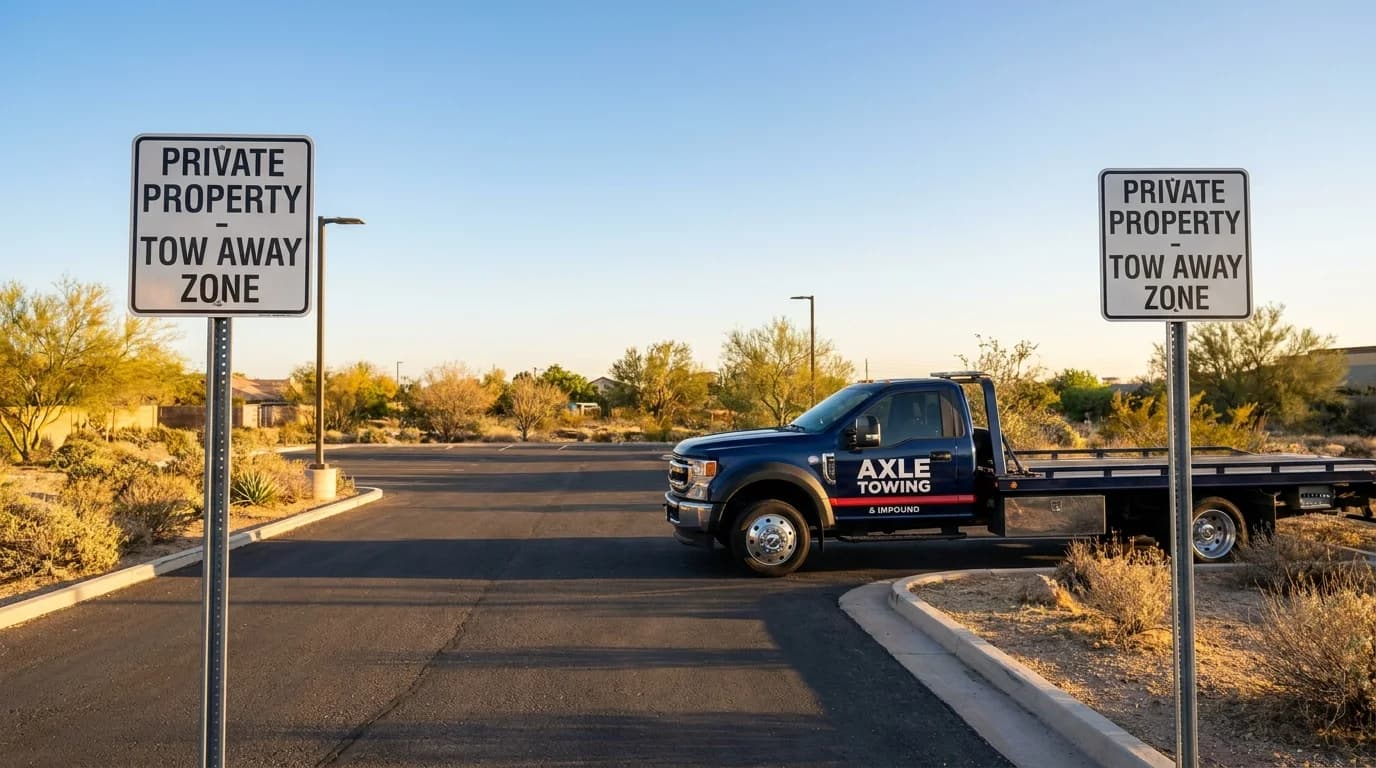
Your towing signs are the foundation of every private property tow you authorize. If a sign is missing, undersized, illegibly worded, or in the wrong location, an entire tow can be challenged - and you may be liable. Arizona sets specific requirements for private property towing signs under ARS 28-3511 and the municipal ordinance framework codified in ARS 9-499.05. This guide gives you the specifics and a visual checklist to verify compliance on your property.
This page is for general informational purposes only and does not constitute legal advice. Sign requirements are derived from ARS 28-3511 and ARS 9-499.05, which are subject to amendment by the Arizona Legislature and supplementation by local municipal ordinance. Always verify current requirements at azleg.gov and with your municipality before ordering or installing signs.
Why Arizona Towing Signage Law Exists
Arizona's towing signage requirements are fundamentally a notice law. Before a vehicle can be towed from private property, the vehicle owner must have had an opportunity to see that their vehicle was subject to removal. Proper signage is how Arizona law creates that constructive notice.
When a tow is challenged in court or in a consumer protection complaint, one of the first things examined is whether the signs were compliant. A sign that was present but not visible from the approach angle, or that was the right size but missing required language, can be found deficient - and a deficient sign can void the tow. This is why sign compliance is not an administrative formality. It is the legal underpinning of your entire enforcement program.
Required Sign Content: What the Language Must Say
Arizona statute requires that private property towing signs include specific information. The required elements are:
- Name of the towing company authorized to remove vehicles from the property. This must be the company that will actually perform the tow - not a generic "violators will be towed" statement.
- Telephone number of the towing company that vehicle owners can call 24 hours a day to locate their vehicle. This must be an active, monitored line - not an office number that goes unanswered after business hours.
- Hours of enforcement during which towing may occur. If you intend to enforce 24 hours a day, seven days a week, the sign must say so explicitly. "24 hours" or "24/7" language is required if you want around-the-clock enforcement authority.
- Notice that violators will be towed at the vehicle owner's expense. The specific language varies, but the substance - that unauthorized vehicles will be removed and the owner bears the cost - must be clear.
- Any permit requirement relevant to the zone. If parking in the area requires a permit, the sign should reference the permit requirement so a driver knows their vehicle is at risk.
Size and Visibility Requirements
Arizona's sign requirements specify minimum dimensions. While exact measurements are set by statute (which you should verify at azleg.gov), the general standard is that signs must be large enough to be legible from the approach distance to the parking area - typically from a vehicle approaching the lot or zone at normal driving speed.
Retroreflective materials are the industry standard for nighttime visibility. A sign that is readable during the day but invisible at night does not provide adequate notice for tows that occur after dark. If you conduct any nighttime enforcement, retroreflective signage is effectively required even if not explicitly mandated in every context.
Font size must be large enough to read from the approach distance. The towing company name and phone number in particular must be legible - a driver who cannot read the phone number from their vehicle has arguably not received adequate notice.
Placement Rules: Where Signs Must Go
Placement is where most sign compliance failures occur. Arizona law requires that signs be placed so that they are visible to any vehicle entering the area subject to towing enforcement. In practice, this means:
- Entry points: At least one sign must be visible from each public street entrance to the parking area. A driver pulling into the lot should see a towing sign before or immediately upon entering.
- Specific zones: Fire lanes, ADA spaces, reserved spaces, and other specifically restricted areas must have their own signage at or adjacent to the zone. An entry-point sign covering the entire lot does not substitute for zone-specific signs.
- Height: Signs should be mounted at eye level for a person standing next to the sign and visible from a vehicle - typically between four and seven feet from the ground. Signs mounted too high or too low may be found inadequate.
- Unobstructed visibility: Signs must not be blocked by vegetation, other signs, structures, or parked vehicles. If a tree branch grows in front of a sign, the sign's notice value is compromised. Trim vegetation regularly and check for new obstructions after any landscaping or construction.
Sign Compliance Visual Checklist
Use this checklist when inspecting existing signs or approving new sign installations. Check every sign on every entrance and enforcement zone.
ARS 9-499.05: How Municipality Rules Layer On Top
ARS 9-499.05 is the Arizona statute that governs how cities and towns may regulate towing services and sign requirements. It sets a framework for local regulation while establishing certain baseline protections. What this means for you: individual cities in the Phoenix metro - Phoenix, Tempe, Scottsdale, Mesa, Chandler, Gilbert, Glendale, and others - may have their own towing signage ordinances that are stricter than the state baseline.
Before installing signs at a property, check the municipal code for the city where your property is located. Your towing partner should be familiar with the requirements for the cities where they operate, but do not assume - confirm in writing that the sign plan they recommend meets both state and local requirements for your specific municipality.
How Axle Towing Helps You Stay Compliant
When Axle Towing starts a parking enforcement program at a new property, we conduct a signage audit as part of the onboarding process. We identify any existing signs that are noncompliant, recommend a minimum-compliant sign plan for the property layout, and can coordinate sign installation so that enforcement begins on a solid legal footing.
We provide signs that meet Arizona's requirements and include our company name and 24/7 dispatch number - meaning every tow performed under those signs is backed by visible, statutory-grade authorization. We also conduct periodic sign checks during patrol visits and notify you if a sign needs replacement.
For a broader view of launching a towing program, see our private property towing program runbook. For HOA-specific signage questions, our HOA towing services page covers common association scenarios.