Key Takeaways
- →A vehicle that has not moved for 72 hours on private property may qualify as abandoned under Arizona law.
- →The 72-hour clock does not start automatically — property managers must document the observation period with dated photos.
- →After 72 hours, a licensed towing company can remove the vehicle under the abandoned vehicle framework.
- →The abandoned vehicle lien process under ARS 28-4141 requires ADOT notification and a waiting period before disposal.
- →Abandoned vehicle cases are separate from standard unauthorized-vehicle towing and follow a different statutory process.
The phrase "72-hour rule" gets tossed around in property management circles as if it were a simple countdown timer. In practice, Arizona's observation window for abandoned vehicles is more nuanced - and getting it wrong can expose your property to disputes, legal challenges, and delays. This guide explains how the clock actually works, what qualifies a vehicle as "abandoned" under Arizona law, and what notice steps must happen before and after removal.
This page is for general informational purposes only and does not constitute legal advice. Arizona statutes are subject to change. Always verify current requirements at azleg.gov and consult a licensed attorney before taking action on any specific vehicle or situation.
Where the 72-Hour Rule Actually Comes From
Arizona's abandoned vehicle framework is rooted in Title 28 of the Arizona Revised Statutes, which covers transportation and motor vehicles. The general principle embedded in that framework is that a vehicle left on private property for 72 hours or more, showing observable signs of abandonment, may be treated as an abandoned vehicle subject to removal and a formal notice process.
It is important to understand that this 72-hour threshold is the floor for the abandoned vehicle track - it is the minimum observation period before a vehicle can be characterized as abandoned. Some circumstances, some types of property, and some local ordinances may require a longer observation window. The 72-hour figure is a starting point, not the entire rule.
Separately, ARS 28-3511 governs standard private-property impounds, which can happen immediately for active violations (no permit, wrong zone, fire lane) when proper signage is posted. The abandoned vehicle process is distinct from the standard impound process and typically involves more steps.
What Counts as "Observable Signs of Abandonment"
Arizona's statute does not provide a neat checklist, which is why having a towing partner who knows the landscape matters. In practice, courts and enforcement officials look for a combination of factors that collectively indicate the vehicle's owner has given up control of it. These include:
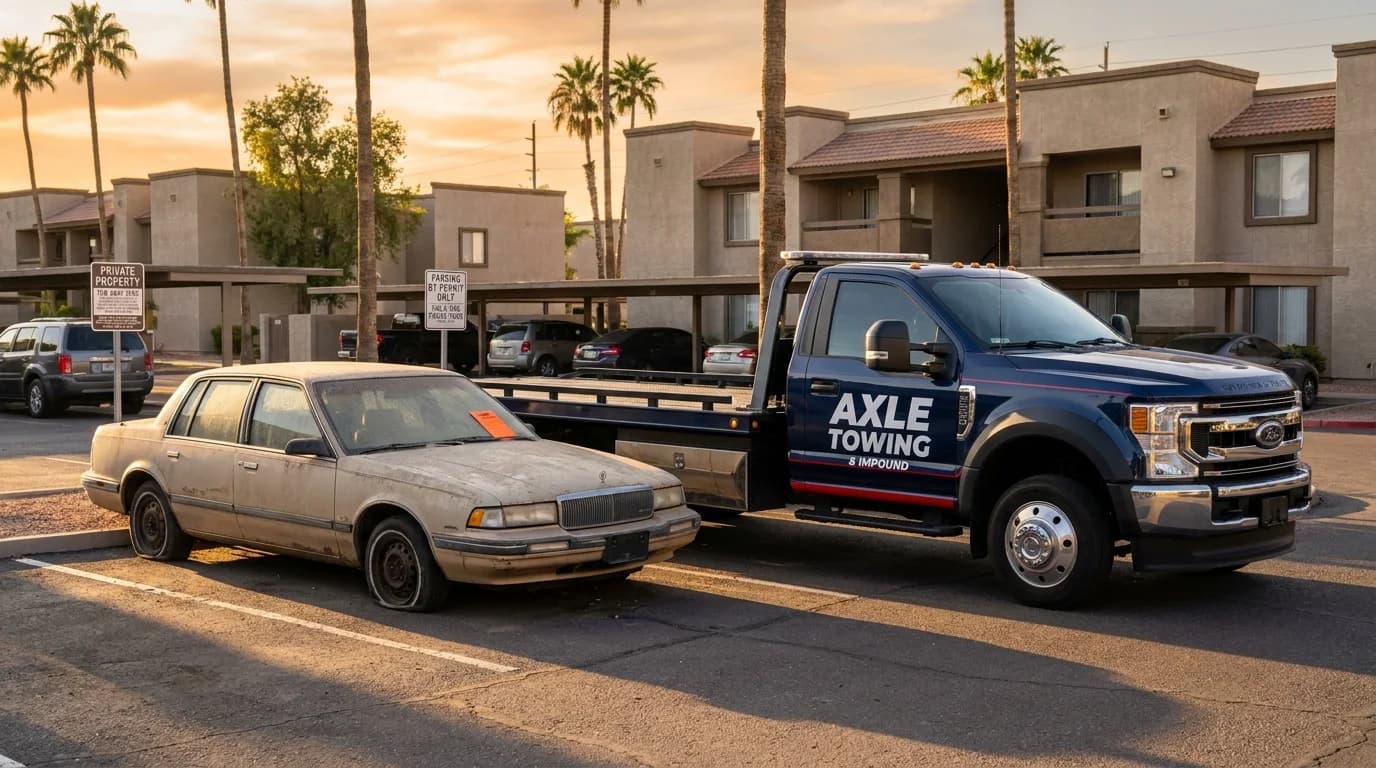
Common Signs Arizona Courts Recognize as Indicators of Abandonment
No single factor is usually sufficient on its own. The stronger and more numerous the signs, the more defensible the abandonment determination.
A vehicle with valid registration, all four tires inflated, and no visible damage is generally not an abandoned vehicle under Arizona law - even if it has occupied the same parking spot for weeks. That situation is better addressed as an unauthorized parking violation under your property's rules and ARS 28-3511.
How the Observation Clock Actually Starts
This is where many property managers get tripped up. The 72-hour clock is not a vague mental note - it needs to be documented with precision. Here is how to start it correctly:
- Photograph the vehicle on Day 1. Date-stamp or time-stamp the photograph. Modern smartphones embed GPS metadata, which is an added layer of evidence. Capture the vehicle's position relative to a fixed landmark (parking space number, building entrance, sign post) so you can show it has not moved.
- Document the abandonment indicators visible that day. Flat tires, expired tags, missing plates - capture each one in a close-up photo. Write a brief note with the date, time, and your observations.
- Photograph again at 24 hours and 48 hours. This creates a timestamped record showing the vehicle did not move during the observation window. Each photograph should show the same position relative to the same landmark.
- At 72 hours, document final state and contact your towing partner. If the vehicle still meets the criteria for abandonment, you are positioned to proceed. Do not skip any day of the documentation series.
The reason this documentation chain matters: if the vehicle owner disputes the removal months later and claims the vehicle was not abandoned, your timestamped photographic series is the evidence that demonstrates the statutory criteria were met. Without it, you are relying on memory against a paper record the owner may have created.
What Notice Is Required and When
Arizona's abandoned vehicle framework builds in notice requirements designed to protect the vehicle owner's right to reclaim their property. The notice obligations generally fall into two stages:
Pre-removal (sometimes called on-vehicle notice): Many property managers and towing companies affix a dated notice to the vehicle's windshield during the observation period. This is not always legally required before the observation window closes, but it creates a visible record that the vehicle was identified as potentially abandoned, and it gives the owner a chance to move it before a tow occurs. Some properties include this step in their parking enforcement SOPs.
Post-removal (statutory owner notice): Once the vehicle is removed, Arizona statute requires the towing operator to notify local law enforcement within 30 minutes and to initiate a title search through ADOT/MVD. Once the registered owner and any lienholder are identified, certified mail notices must be sent informing them of the vehicle's location, the storage charges accruing, and the steps required to claim it.
The property manager's role in the notice process is primarily to retain a copy of the towing company's post-removal filings and to respond promptly if the owner contacts you directly. Direct the owner to the towing operator and the impound yard - they control the vehicle and the release process, not the property.
Common Mistakes That Expose Properties to Liability
Over years of working with property managers across the Phoenix metro, the team at Axle Towing has seen the same mistakes repeat. Here are the most common:
- Towing before the observation period is complete. Even if a vehicle looks abandoned on Day 1, removing it before 72 hours without meeting the immediate-hazard exception creates legal exposure.
- Not documenting the observation period at all. "I know the car has been there for weeks" is not defensible evidence. Photographs with timestamps are.
- Using the abandoned vehicle process for standard violations. If a car is parked without a permit but otherwise operational, the immediate impound process under ARS 28-3511 is faster and legally cleaner.
- Mixing up the two processes mid-stream. Starting with an abandoned vehicle observation and then impounding the car as a standard violation (or vice versa) creates a murky paper trail. Pick the right track from the beginning.
- Failing to retain documentation. Vehicle owners sometimes file disputes years after the fact. Retain your photos, authorization forms, and copies of towing company filings for at least three years.
How Axle Towing Makes the 72-Hour Process Manageable
Axle Towing provides abandoned vehicle removal services for apartment complexes, HOA communities, and commercial properties across the Phoenix metro. When you call us about a potential abandoned vehicle, we can walk you through the observation checklist, advise on whether the vehicle qualifies under the abandoned vehicle track or the standard impound track, and coordinate the documentation and filing process once the observation window closes.
For properties running regular parking enforcement programs, we integrate abandoned vehicle monitoring into the regular patrol cadence so issues are identified and documented from Day 1 - no scrambling at the end of a 72-hour window.
Related resources: our guide to abandoned vehicle paperwork covers the specific forms and filing sequence in detail. The parking enforcement checklist includes a section on how to build abandoned vehicle monitoring into your weekly routine.