Dispatch Available

Parking Enforcement Checklist for Property Managers: Daily, Weekly, and Monthly Tasks

A practical daily, weekly, and monthly checklist for property managers running a private parking enforcement program. Fits into a Friday-morning admin routine.

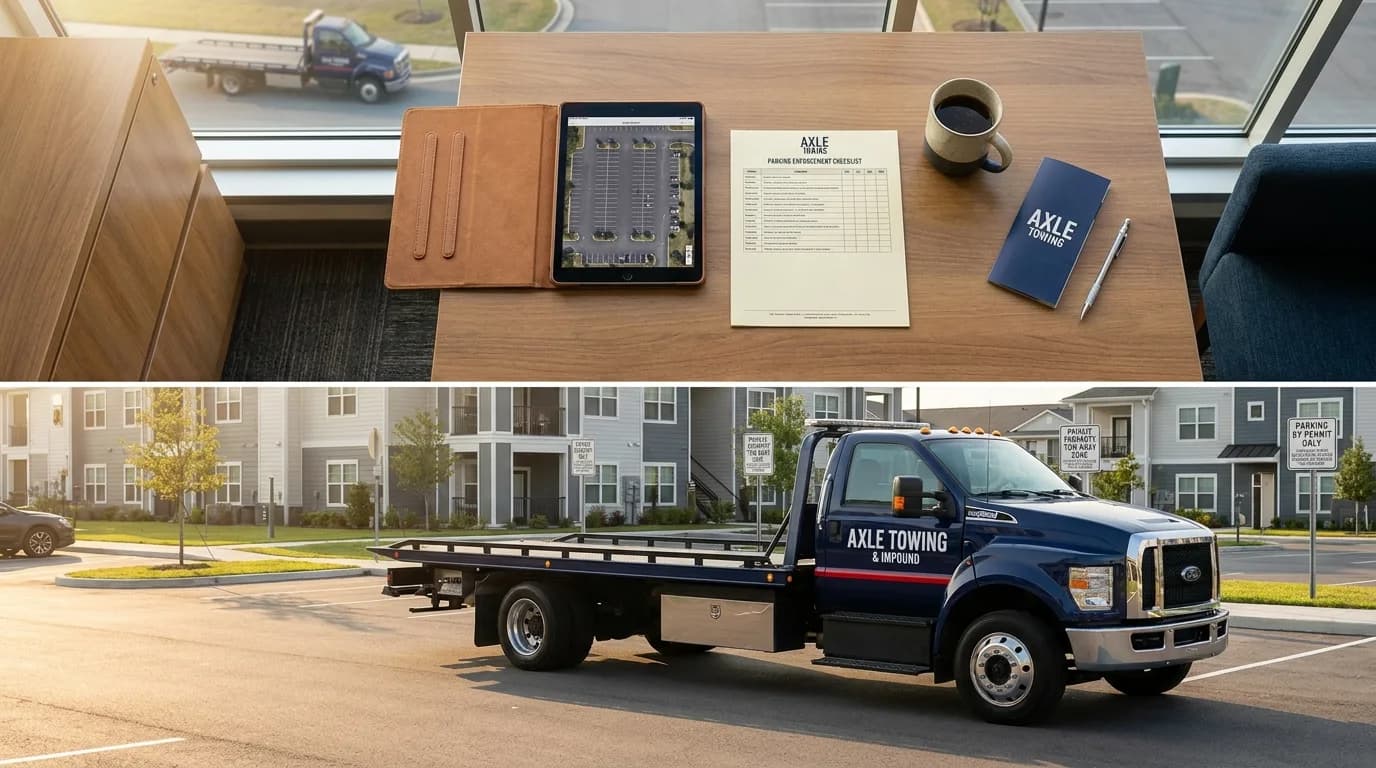
Professional tow truck at a systematic organized Arizona parking lot with enforcement signs - Axle Towing checklist

Key Takeaways

  • A written authorization agreement and ARS-compliant signage are the two non-negotiable legal prerequisites before any tow.
  • All parking rules must be documented in writing and distributed to every occupant before enforcement begins.
  • Permit systems should clearly identify authorized vehicles with visible decals or permits to simplify enforcement.
  • Monthly tow reports from the towing partner provide accountability and early detection of emerging problem areas.
  • A documented dispute resolution process protects the property manager when vehicle owners contest a tow.

A parking enforcement program that runs on autopilot is not a program - it is a liability waiting to happen. Signs go missing. Permits expire. New residents arrive without learning the rules. Vehicles accumulate in corners. The difference between a program that works and one that generates complaints is consistent, lightweight management. This checklist is designed to keep your program sharp without consuming your schedule.

How to Use This Checklist

This checklist is organized by cadence: daily, weekly, and monthly. Most properties running a managed parking enforcement program with a towing partner handling patrols and documentation will find that the daily items take only a few minutes, the weekly items fit into a Friday-morning routine, and the monthly review takes about an hour. Adjust frequency based on your property size, violation history, and the complexity of your permit system.

Daily Checklist (5-10 minutes)

Most of these items happen naturally during your daily walk-through or morning arrival. They are not a separate activity - they are a trained eye during work you are already doing.

Note any vehicles that appear to be in the same position as yesterday, especially in low-traffic areas
Check that fire lane signage is visible and unobstructed - these are your highest-liability zones
Flag any vehicle with visible signs of potential abandonment (flat tires, broken windows, no plates)
Take a dated photo of any flagged vehicle - this starts your documentation chain
Log any verbal complaints from residents about parking - date, name, specific concern
Forward any new resident move-in information to your towing partner for permit records (if applicable)

Weekly Checklist - Friday Morning (30-45 minutes)

Friday morning works well because you can resolve any issues before the weekend, when coverage gaps are most common and tow disputes are hardest to address.

PATROL REPORTS
Review any patrol reports received from your towing partner this week
Confirm that each tow this week has a patrol report with photos and law enforcement notification
Note any new violation patterns - new location, new violation type, or same vehicle repeat
File reports chronologically in your parking enforcement records folder
RESIDENT COMMUNICATIONS
Respond to any unresolved parking complaints in the resident portal or email queue
Follow up on any resident permit requests that have been pending more than 48 hours
Note any units with move-outs in progress - confirm their parking permit is deactivated if applicable
If a specific unit or vehicle has been towed multiple times this month, note it for the monthly review
SIGNS AND PROPERTY
Check that all towing signs at property entrances are visible and undamaged
Check that fire lane and ADA zone signs are intact after any landscaping, maintenance, or delivery activity this week
Confirm that any visitor parking areas are functioning as intended (not being captured by residents)
Note any new vehicles parked in the same spot for 48+ hours in an unusual location

Monthly Checklist (45-60 minutes)

The monthly review is where patterns become visible and decisions get made. Block 45-60 minutes on the last business day of each month.

PERFORMANCE REVIEW
Total tows this month vs. last month - is the number trending up, down, or flat?
Breakdown of tow reasons (no permit, fire lane, ADA, wrong zone, after-hours) - is any category spiking?
Identify any zones with zero tows - are these genuinely compliant or are they not being monitored?
Review repeat-tow vehicles - same license plate appearing 2+ times deserves a written notice or escalation
Confirm that all tows have complete documentation (photo, report, law enforcement notification)
PERMIT SYSTEM AUDIT
Compare current permit list against current resident/tenant roster - deactivate permits for move-outs
Issue permits for any new residents or tenants who moved in this month
Confirm that visitor permit limits are being observed if your property uses visitor permits
Check for expired permits still in circulation
SIGNAGE AND COMPLIANCE
Photograph all towing signs once per quarter - note any that need replacement
Confirm your towing company's license and insurance are still current (request updated certificate if annually)
Review any open disputes or complaints from this month and confirm they are resolved or escalated
BOARD OR OWNER REPORTING
Prepare the monthly towing summary for your board or ownership report (see monthly compliance report template)
Flag any significant incidents (disputed tow, abandoned vehicle case, signage damage) for inclusion in the report
Note any recommended changes to enforcement rules, zones, or hours for board/owner consideration

Special Situation: Abandoned Vehicle Monitoring

Abandoned vehicles require their own documentation cadence that does not fit neatly into the daily/weekly/monthly structure above. When you flag a potentially abandoned vehicle during a daily check, start a dedicated log for that vehicle:

  • Date and time of first observation, with photograph
  • Vehicle description (make, model, color, plate, registration expiration if visible)
  • Daily photographs for a minimum of 72 hours
  • Any observed movement (even slight repositioning)
  • Date and time your towing partner was notified

See our full guide to Arizona's 72-hour abandoned vehicle rule and our abandoned vehicle paperwork guide for the specific procedures once the observation window closes.

Connecting the Checklist to Your Monthly Report

The weekly and monthly checklist items feed directly into the monthly compliance report you share with your board or management company. If you have been diligent about the weekly reviews, the monthly report becomes a summary exercise rather than a research project.

See our monthly towing compliance report template for a structured format that satisfies most board, insurer, and management-company documentation requirements. The template maps directly to the monthly checklist items above.

For HOA boards reviewing this checklist in the context of their broader governance responsibilities, see our HOA board guide to towing and parking enforcement.

Frequently Asked Questions

How much time should a property manager spend on parking enforcement each week?
For a property with an active towing partner handling patrols and documentation, most of the ongoing management work fits into 30 to 60 minutes per week: reviewing patrol reports, responding to any resident inquiries about tows, and noting any new problem areas. Monthly review takes about an hour. If you are spending more time than this on reactive issues, that is a signal your enforcement program or communication strategy needs adjustment.
Should I walk the property every day to check for violations?
For properties with active patrol agreements, daily management walks are usually not necessary for towing purposes. Your towing partner's patrol visits handle routine violation identification. Daily walk-throughs are most useful for properties where you also manage maintenance, landscaping, and safety - combining purposes. If your property is experiencing a specific ongoing problem (serial violators, blocked fire lanes), more frequent checks make sense until the issue resolves.
What should I do when a resident calls to complain about a tow?
Listen calmly, take notes, and ask for the vehicle description, date, and location of the alleged violation. Pull your towing records for that date and confirm whether a patrol report and photos exist for that tow. Refer the vehicle owner to the towing company for vehicle release - your role is to confirm the authorization, not to manage the vehicle. If you find the tow was in error, contact your towing partner immediately to arrange a release. Document everything and report the incident to your management company if applicable.
What records should I keep from my towing partner's patrol reports?
Keep every patrol report your towing partner provides, even those with no tows. Zero-tow patrol reports prove that the property is being actively monitored, which strengthens your enforcement program if it is ever challenged. File reports by date and keep them for at least three years. Some management companies and insurers specify longer retention periods - check your management agreement.
How do I handle a vehicle that has been parked in the same spot for several days without moving?
Start the abandoned vehicle documentation process immediately. Take a dated photograph showing the vehicle's position relative to a fixed landmark. Note the license plate, make, model, and color. Check the registration sticker for expiration. Return daily for photographs. After 72 hours with no movement and observable signs of abandonment, contact your towing partner to evaluate the vehicle and initiate the appropriate removal process. See our guide on Arizona's 72-hour rule for the full procedure.
Should the parking enforcement checklist be different for an HOA versus an apartment complex?
The core tasks are similar, but HOA properties typically require additional coordination with the board, formal documentation for any policy changes, and communication to homeowners (who own their units) rather than tenants. HOA boards often want monthly reports that can be shared at association meetings. Apartment complexes typically have more centralized decision-making but higher resident turnover, which means permit systems need regular auditing.

Need a Hand? Talk to an Operator.

Free consultation for property managers, HOA boards, and commercial owners across the Phoenix metro. 24/7 dispatch available.

How can we help?

Choose an option below

Property Manager Assistant

Axle Towing & Impound

Tap to Call Now